Trees for Wimborne
Contact Us
To find out more about Trees for Wimborne please email us at treesforwimborne@gmail.com. We send out periodic updates for our activities on a mailing list, if you would like to be added to this list please mention in your enquiry.
About Us
Trees for Wimborne (TfW) are one of several projects of Wilding Wimborne which became a CIO in 2025.
TfW are a small community action group with a big vision; we would like to see a significant increase in tree numbers in and around Wimborne. Our scope includes growing Native Black Poplars our rarest large tree and at home in wetlands.ant.
We were formed at the end of COVID and got planting as soon as we could. We use a variety of sources for our trees depending on the workstream, and many of the trees we have been planted have been gifted. We also grow trees ourselves, mainly Native Black Poplars. Despite having been busy since our inception we have a long way to go to reach our vision for Wimborne.
We know we cannot do this on our own and we hope that everyone will play their part whether they are individuals, organisations, landowners or public bodies.
If you would like to help please contact treesforwimborne@gmailcom
Our Work
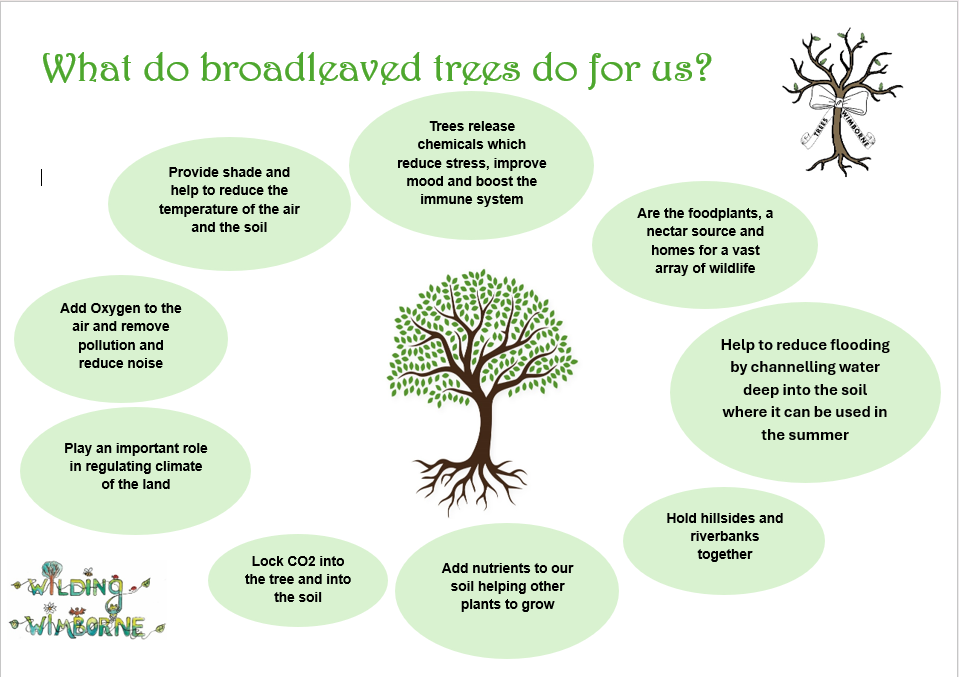
We now know that trees bring many benefits in towns including improving the health and wellbeing of all the inhabitants as well as creating a greener, more comfortable and enjoyable places to live.
All urban populations are facing biodiversity loss, rising temperatures, more frequent and extreme weather events including windier wetter winters and hotter drier summers. While Wimborne due to its small size and rural location is partially buffered from some of these effects we cannot escape them all and action is required.
Urban trees are a proven, nature-based solution to help us with the climate crisis, cooling the streets and greenspaces, reducing the risk of flooding as well as providing space for nature and wildlife to thrive.
But like many places in the UK we have much less tree cover than the rest of Europe. Many towns and cities are working hard to redress this by planting large numbers of trees and we think that Wimborne should be following this example.
Our Greenspaces
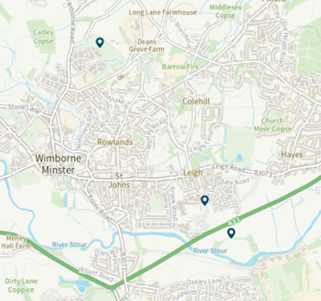
We have created areas of new habitat and are restoring existing habitat on 3 very different sites, all well used by the public and owned by Dorset Council.
We have planted over 2,000 trees on these sites, in each of the sites we have tried to add diversity of species, structure, colour, blossom and fruits, nuts and seeds. Each has its own character.
Our Planting Projects
Dogdean SANG is a pastoral landscape and we have added to the hedgerows as well as provided areas of woodland fringe. One of several standards we have planted is the Small Leaved Lime, this is underrepresented in the UKs woodlands but is an incredibly good source of nectar for bees, and according to Professor Dave Goulson of Sussex University, one tree can attract more than 10,000 bees!
Stourview SANG is a wetland site and we have planted mainly wetland species including Goat Willow which flowers early in March, there is at least one species of bee which times its emergence to coincide with the flowering of this tree. You can also see our young Native Black Poplars here.
Ainsley Road Here we are restoring an old hedgerow and creating a narrow woodland tongue. The character changes along the length of the hedge and so will provide a range of habitats. Look out for the wild fruit trees at the southern end.
Many of the trees that have been planted have been grown by TFW but we have also received saplings from the Woodland Trust.
Our Streets
Many of the older parts of the town were provided with trees by forward thinking Victorians who recognised the importance of trees in our towns. Some of our recently built areas have also benefited from street tree planting as part of the Planning rules. But there are many streets that fall in between and have few if any trees. Some of these are thoroughfares, but even the smallest of them are used to walk and to cycle. In the summer they can be uncomfortably hot.
We would like to see more areas in Wimborne benefitting from tree cover which would keep the ground and the air cool.
This is going to take a lot of work to take this stream of work forward and so far, sadly, we have nothing to celebrate, yet!
Our Black Poplars
Our Native Black Poplar project is such a central part of what we do it warrants it’s own page. Please click this link Native Black Poplar to explore more.